Mushrooms on Your Tree: What They're Telling You
You Noticed Something Growing on Your Tree
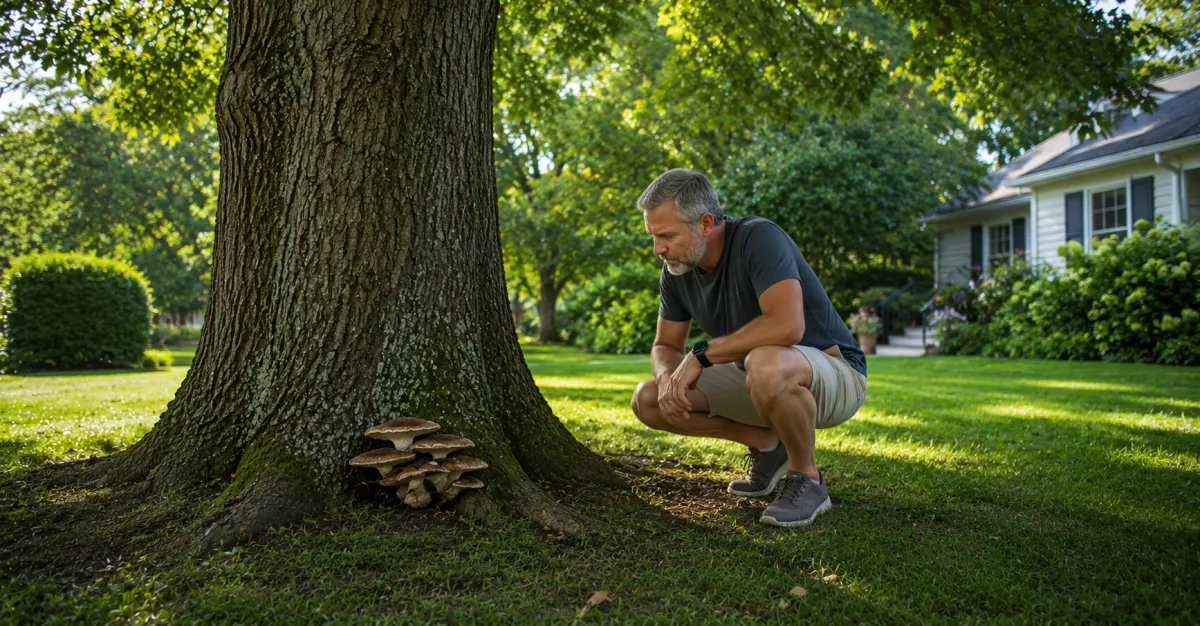
It might be a cluster of mushrooms at the base. Or a shelf-like growth jutting out from the trunk. Or a bracket of tan and brown rings on the bark halfway up. Whatever it looks like, you noticed it — and now you’re wondering what it means.
The honest answer is: it depends. Not all fungal growth on or near a tree is cause for alarm. But some of it is a serious warning sign, and knowing the difference is worth understanding.
The Mushroom Is Not the Problem — It’s the Messenger
This is the key thing to understand about any fungal growth you see on a tree. The mushroom or shelf fungus you can see above ground is the fruiting body — the reproductive structure of a fungal network that exists inside or around the tree’s wood. By the time that fruiting body appears, the fungal organism has already established itself.
Knocking the mushrooms off doesn’t do anything meaningful. The underlying network remains. The right response is to understand what kind of fungus you’re dealing with and what it means for the tree’s structural integrity.
Three Scenarios
Scenario 1: Mushrooms growing in the soil near the tree, not on the tree itself
Mushrooms popping up in the lawn around a tree’s root zone are often — not always, but often — a sign of healthy soil biology. Fungal networks in soil frequently have beneficial relationships with tree roots, helping them absorb water and nutrients more efficiently. If the tree looks healthy and the mushrooms aren’t growing on the tree itself, this is usually nothing to worry about.
Scenario 2: Shelf fungus or bracket fungus on the trunk or major branches
These hard, layered growths — sometimes called conks — are a more significant signal. They typically indicate that the tree has a rot-inducing pathogen inside the wood. The decay may be in the heartwood (center of the trunk) or the outer sapwood, and the extent of it isn’t visible from the outside.
A tree with bracket fungus on the trunk or main branches may still appear outwardly healthy — full canopy, green leaves — while the interior has been significantly compromised. The structural implications depend on where the fungus is, how large it is, and how far the decay has progressed. This is a situation where having someone take a closer look is worthwhile.
Scenario 3: Clusters of mushrooms at the base of the trunk or around the root zone
This is the highest-concern scenario. Mushrooms growing right at the base of the trunk — particularly honey fungus (yellowish-brown, grows in clusters, distinctive ring on the stem) and armillaria species — are associated with root rot and butt rot. These fungi attack the root system and the base of the trunk, which is exactly where the tree’s structural foundation is.
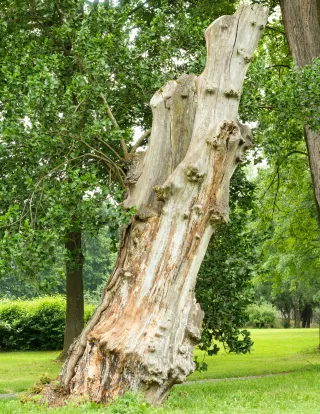
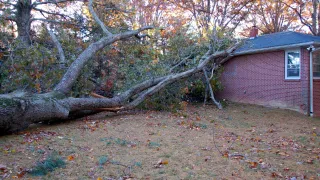
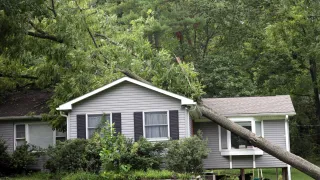
A tree with significant root or butt rot can appear completely normal above the ground while having severely compromised structural integrity below. In summer storm conditions, this is a meaningful fall risk.
What to Look For Beyond the Mushrooms
If you’re assessing a tree that has fungal growth, also look for:
Dead branches or sparse canopy in an otherwise green yard
Soft, spongy, or hollow-sounding wood when you tap the trunk
Bark that’s loose, separating, or falling away
Woodpecker damage — heavy pecking activity often follows the insects that follow the decay
A new lean or soil disturbance at the base
Sawdust-like debris at the base of the trunk (indicates boring insects)
The more of these you see alongside the fungal growth, the more urgency there is to have someone assess the tree.
Can It Be Treated?
For most root rot and internal decay fungi, there is no cure. The fungus can’t be eliminated once it’s established inside the wood. What a professional assessment can tell you is how far the decay has progressed, whether the tree is still structurally sound enough to be safe, and what the realistic timeline looks like.
Some trees can stand with significant internal decay for years without failing. Others are much closer to the edge than they appear. The variables — species, size, location of decay, proximity to structures — are why an in-person look matters more than a general rule.
Summer Is When This Matters Most
Fungal fruiting bodies are most common in late summer and fall, when conditions are right for reproduction. This means if you’re going to spot this kind of growth, summer through early fall is often when it appears. It’s also — as we’ve covered — the season when tree failures happen most frequently.
If you’ve noticed something growing on a tree on your property and you’re not sure what to make of it, feel free to reach out. A quick look can tell us a lot.
Call or text (423) 443-4533 — we’re happy to take a look and give you an honest read.