Why September Storms Hit Trees Differently
We're a long way from the coast. Three hundred and some miles from the Gulf, tucked in behind a couple of mountain ranges. Nobody in Chattanooga is boarding up windows.
But we do get the leftovers. When a system comes ashore on the Gulf Coast and works its way north, what reaches the Tennessee Valley a day or two later isn't a hurricane — it's a slow, soaking, unusually persistent weather pattern. And that pattern does something to trees that our regular thunderstorms don't.
September storms are genuinely different from the storms we get the rest of the year, and understanding why explains a lot about which trees come down and which ones don't. This isn't a warning that your trees are about to fall over. Most of them aren't. It's an explanation of what actually changes in the next few weeks, and what's worth a look while you've still got easy weather to do it in.
What Actually Reaches Us
A summer thunderstorm in June is violent and brief. Thirty minutes of hard wind, maybe some hail, and then it's over and the ground drains.
What comes up from the Gulf in late summer is the opposite shape: moderate wind that doesn't stop, and rain measured in days rather than inches per hour. The system stalls, the moisture keeps feeding in, and you get a Tuesday through Thursday of gray, wet, breezy weather that never quite becomes dramatic.
That's a much harder test for a tree than a violent thunderstorm is. And it's why the tree that stood through a nasty squall line in June can come out of a mild-looking September system leaning.
Saturated Soil Is the Real Story
Here's the part that matters most, and it has almost nothing to do with the wind speed.
Most trees that fail in these events don't snap. They come out at the roots. The trunk stays intact, the canopy stays intact, and the whole tree tips over with a plate of soil and roots lifting out of the ground.
The reason is that a root system's grip depends on the soil around it. Dry, firm clay holds a root plate like concrete. Clay that's been absorbing rain for three straight days turns into something closer to pudding. The tree hasn't changed at all — the ground holding it has.
So the equation in September is: soil at its weakest, wind that doesn't let up, and pressure applied for hours instead of minutes. A tree that has been perfectly stable for forty years is being tested against different physics than it's used to.
The Wind Comes From the Wrong Direction
This one is subtle and I find it's the thing that surprises people most.
Trees adapt to the wind they normally get. Around here, the prevailing weather comes out of the west and southwest, and over decades a tree responds — it lays down extra supporting wood on the loaded side, thickens the roots that take the most tension, and effectively braces itself for the direction the wind usually comes from.
Systems tracking up from the Gulf frequently push wind at us from the east and northeast — close to the opposite of what a tree has spent its life preparing for. All that carefully built structural reinforcement is on the wrong side.
That's a real part of why storm damage in these events looks scattered and unfair. It's not always the tree you'd have picked.
Full Leaves Mean Maximum Sail
The third factor is timing within the year.
In September the canopy is still fully leafed out, and after days of rain every one of those leaves is holding water. A tree at this point in the season is presenting the largest, heaviest wind-catching surface it will present all year.
Compare that to a January ice storm, where the tree is bare and the load is coming from ice weight rather than sail area. Same tree, completely different failure mode.
Late summer is simply when a tree has the most to catch the wind with.
What's Worth Looking At in the Next Couple of Weeks
You don't need a checklist and a clipboard. Walk the property once on a nice evening and notice a few specific things.
- Has the lean changed? Not "is it leaning" — plenty of trees lean happily for a century. Has it moved recently? A fresh lean, or soil that's cracked, heaved, or mounded on one side of the base, is the single most meaningful thing on this list.
- Deadwood in the canopy. Bare gray limbs with no leaves while the rest of the tree is green. These are the first things to come down and they come down in ordinary wind, not just storms.
- Where two trunks meet in a tight V. If a tree forks into two big stems at a narrow angle with bark pinched between them, that union is weaker than it looks. Wide U-shaped forks are much stronger than tight V-shaped ones.
- Regrowth on a previously topped tree. If a tree was topped years ago, the thick upright shoots that grew back are attached poorly to decaying stubs. They're heavy now and they're not well anchored.
- Mushrooms or soft, punky wood at the base or on the root flare. That can indicate decay in exactly the part of the tree that's doing the most structural work.
- What's underneath it. This matters as much as the tree does. A questionable tree in the back corner of an acre is a very different situation than the same tree over a bedroom, a driveway, or the neighbor's fence.
Most of what you'll find is nothing. That's the normal outcome and it's a fine outcome.
What Actually Helps — and What Doesn't
There's a lot of well-meant advice in this area, and some of it makes trees less safe.
Removing genuine deadwood helps. It's the lowest-risk, highest-value storm prep there is.
Thoughtful, selective thinning can help in specific cases — but this is easy to overdo. Stripping the interior branches and leaving foliage only at the ends, sometimes called lion-tailing, is a common and genuinely harmful practice. It concentrates weight at the tips of long unsupported limbs and moves the tree's center of mass outward. It looks tidy and it makes failure more likely, not less.
Cabling or bracing is a real solution for a specific problem — usually a valuable tree with a weak union worth preserving. It's not general-purpose storm insurance and it requires ongoing inspection.
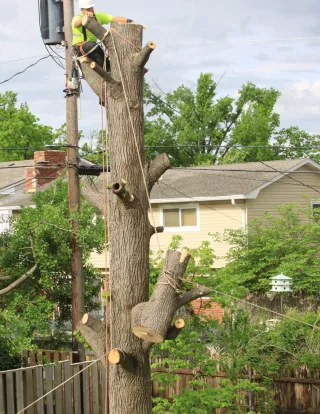
Topping does not help. It never has. A topped tree grows back weaker, faster, and worse attached than it was before.
And sometimes the honest answer is that a particular tree in a particular spot has reached the end of being worth keeping. That's not a fun conversation and I don't enjoy having it, but it's better had in September than after.
Having a Plan Beats Having a Worry
A few unglamorous things that make a bad night much easier:
Know who you'd call before you need to call them, and have the number in your phone rather than in a search bar during an outage. Know roughly what your homeowner's policy covers on tree damage and removal — that varies more than people expect, and your agent can tell you in five minutes. Take a few photos of your trees now, while they're standing and healthy, because documentation before the fact is worth a lot afterward.
And if the power's out and a line is down, that's the utility's call, not a tree service's, and not yours.
The Honest Summary
Most trees in most yards will get through September the way they've gotten through every other September. This isn't a reason to be nervous about your trees.
It's just a good few weeks to actually look at them — while the weather's easy, while you can see the whole canopy, and while a small correction is still a small correction.
If you find something you're not sure about, or you'd like a second opinion on a tree you've been quietly wondering about for a while, we're glad to come look. Estimates are free, there's no pressure either way, and "it's fine, leave it alone" is an answer we give often. Call or text (423) 443-4533 — and we do answer for genuine emergencies around the clock.