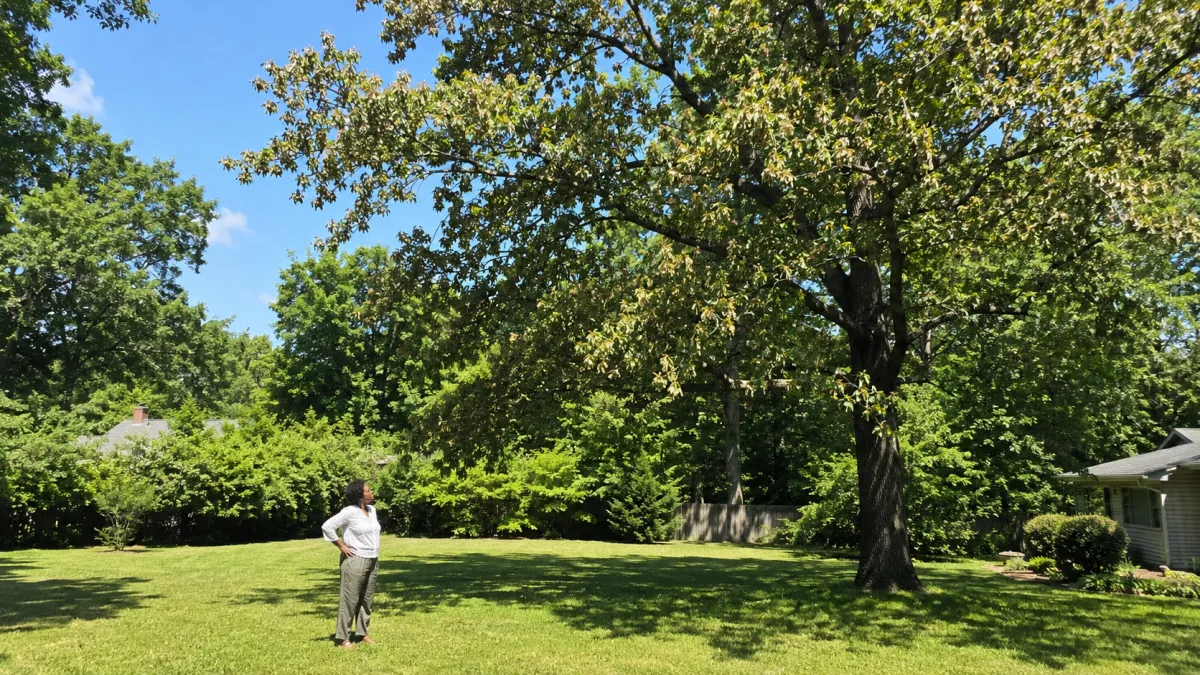
When the Heat Gets to Your Trees: What to Watch For This Summer
It’s Been Hot — And Your Trees Feel It Too
We’ve had some warm stretches already this summer, and if you’ve been spending time outside, you’ve probably felt it. What’s easy to forget is that your trees are out there in it every single day — no shade to duck under, no cold drink to grab. And when the heat builds up week after week, trees start to show it.
The tricky part is that heat stress doesn’t always look dramatic. It can be subtle — a few leaves that look off, a branch that seems thinner than it should, some early color showing up where it has no business showing up in June or July. By the time it looks really bad, the tree has usually been struggling for a while.
Here’s what to watch for, and what you can do about it.
How Heat Stress Actually Works
Trees handle heat through a process called evapotranspiration — they pull water up through their roots and release it through their leaves, which keeps the internal temperature regulated. Think of it like sweating. When it’s hot and dry, that process has to work overtime. If the soil doesn’t have enough moisture to keep up with demand, the tree starts to fall behind.
Once a tree gets behind on water, everything slows down. Photosynthesis drops off. The tree starts pulling energy from reserves. And eventually, those reserves run thin — which is when you start to see the symptoms.
One thing worth knowing: trees run on tree time. Stress from a dry spell in June might not fully show up until August or September. You can have a week of good rain and still see a tree struggling — because it’s responding to what happened weeks ago, not what happened yesterday.
Signs Your Tree Is Heat-Stressed
Wilting or drooping leaves — especially on the outer tips of branches. Leaves may feel dry or papery rather than crisp.
Curling or cupping leaves — the leaf curls inward to reduce the surface area exposed to sun. The tree is trying to conserve moisture.
Brown or scorched leaf edges — sometimes called leaf scorch. Starts at the tips and margins, works inward. Often looks like the leaf has been burned.
Early color change — if a maple or other deciduous tree starts showing fall color in July, that’s a stress response, not an early autumn.
Premature leaf drop — some trees will drop leaves mid-summer to reduce the amount of water they need to move. It looks alarming, but it’s a survival strategy.
Thin or sparse canopy — if a tree that normally has a full, dense canopy suddenly looks see-through, it may be dropping leaves or failing to produce new growth.
Slowed or stopped new growth — if the tips of branches aren’t producing new shoots when they should be, the tree is conserving energy.
Which Trees Are Most Vulnerable?
In the Chattanooga area, newly planted trees — anything in the ground less than two or three years — are at the highest risk. Their root systems haven’t had time to spread out and find deep moisture, so they’re entirely dependent on what’s right around them.
Beyond new plantings, a few things make established trees more vulnerable:
Compacted soil — common in yards with heavy foot traffic or near driveways. Water can’t penetrate as easily, and roots can’t grow as freely.
Shallow root systems — trees planted in thin soil over rock or hardpan.
Trees near pavement or heat-reflecting surfaces — they’re dealing with higher ambient temperatures than the rest of the yard.
Trees that were already stressed — anything that came through spring with some storm damage, a recent pruning, or a pest issue is starting summer at a disadvantage.
What You Can Do
Water deeply and infrequently. This is the single most important thing. A slow, deep soak once a week does far more good than a quick spray every day. The goal is to get moisture down 6 to 9 inches into the soil — deep enough that the roots actually find it. Shallow watering encourages shallow roots, which makes the problem worse over time.
Water in the early morning when evaporation is lowest. If you can use a soaker hose or drip system laid out to the drip line — the outer edge of the canopy — that’s ideal. That’s where most of the feeder roots are.
Mulch around the base. A 3-inch layer of mulch over the root zone does a remarkable job of holding moisture in the soil, keeping ground temperatures lower, and reducing the stress cycle. Just make sure the mulch isn’t piled against the trunk — leave a gap of a few inches. Think donut, not volcano.
Skip the fertilizer. A heat-stressed tree doesn’t need more to do. Fertilizer pushes growth, and a tree that’s already struggling to stay hydrated doesn’t have the resources to support it. Hold off until fall.
Avoid heavy pruning. Summer isn’t the ideal time for major pruning on a stressed tree. You can remove dead or broken branches, but taking off healthy live wood puts additional stress on a tree that’s already working hard.
When to Call for a Second Opinion
If a tree has been showing multiple symptoms for several weeks — especially if it’s near your home — it’s worth having someone take a look. Sometimes what looks like heat stress is actually the beginning of something else: a pest infestation, a fungal issue, or a root problem that the summer heat just brought to the surface.
I’ve seen plenty of situations where a homeowner noticed the tree looking rough in August and assumed it was just the heat, only to find out in the fall that there was more going on underneath. Early eyes make a real difference.
If you’re not sure what you’re looking at, feel free to call or text us at (423) 443-4533. Sometimes a quick conversation is all it takes to know whether to keep watching or take action.
The Bottom Line
Summer heat stress is real, and Chattanooga summers are long. A tree that gets some attention now — good watering, a fresh layer of mulch, and a watchful eye — will come through fall in much better shape than one that gets nothing until the damage is obvious.
You don’t have to do everything perfectly. You just have to pay a little attention.