Your Trees Are Part of Your Outdoor Living Space — Are They Doing Their Job?
A Yard You Actually Want to Spend Time In
Most people think about their trees as something to manage — trim the dead stuff, remove the problem ones, keep things from getting out of hand. That’s all valid. But it leaves out something worth considering: your trees are also architecture.
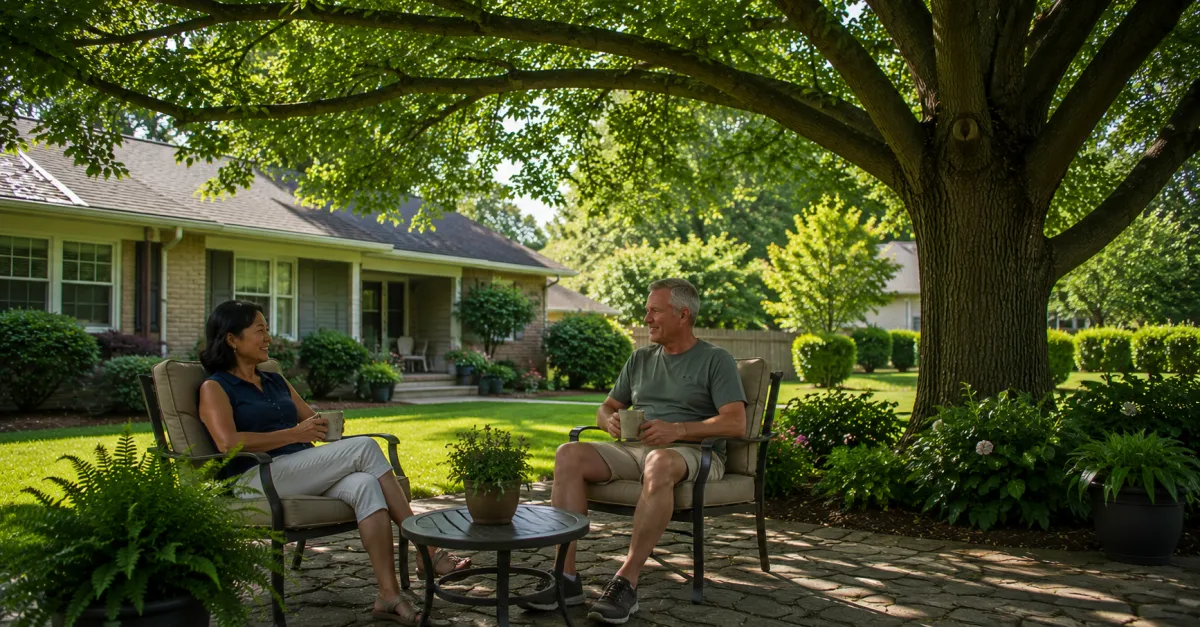
A well-placed, well-maintained shade tree can make an outdoor space genuinely comfortable in the middle of a Chattanooga July. The temperature under a healthy tree canopy can be meaningfully cooler than the open lawn beside it. If you’ve got a patio, a seating area, a stretch of lawn where kids play — the tree overhead changes how usable that space actually is.
The flip side is also true. An overgrown or poorly shaped tree can make a space dark, damp, and uninviting. Or it can be so thick that nothing grows underneath it. Or it can be dropping branches or debris in ways that make you not want to be out there.
The difference is often a matter of thoughtful canopy management — not removing trees, but shaping how they relate to the space below them.
What Canopy Management Actually Means
Canopy management for outdoor living comes down to a few specific goals:
Crown raising — removing lower branches to increase clearance between the ground and the canopy. This opens up sightlines, lets more light reach the lawn and beds, and creates the usable space underneath the tree that makes it feel like an outdoor room rather than an obstacle. For a patio or seating area, you generally want the lowest permanent branches somewhere around 8 to 10 feet off the ground.
Crown thinning — selectively removing branches from the interior and outer edges of the canopy to let more light filter through. A thinned canopy provides shade without the heavy, closed-in feel of an untouched overgrown tree. Dappled light is often more pleasant to sit in than total shade, and a thinned canopy is also more wind-resistant because air moves through it rather than pushing against it as a solid mass.
Deadwood removal — taking out dead, dying, or weakly attached branches that have no business being over a space people use. This is also just good safety practice regardless of how you use the space.
Structural pruning — correcting crossing branches, competing leaders, or growth patterns that will cause problems down the road.
What You Get From It
Done well, this kind of work changes how a yard feels. Spaces that were too dark to grow grass or plants become usable again. Patios that were shaded out become comfortable afternoon spots. Lawn areas that were perpetually soggy because they never got any sun dry out.
There’s also a less obvious benefit: trees that are well-maintained tend to stay that way. Regular attention — taking out dead wood, addressing structural issues early — prevents the kind of problems that lead to emergency removals down the road.
What to Look for in Your Own Yard
Walk your yard and think about the spaces you have and the spaces you wish you had. Then look at the trees in relation to those spaces.
Is a tree shading an area so completely that you avoid it?
Are lower branches scratching cars, blocking sightlines, or making mowing difficult?
Is a patio or seating area sitting in dense shade that never quite dries out?
Are there branches hanging over the space you actually use that you’ve been half-worried about?
These are all solvable problems — and summer, when you’re actually out there trying to use the space, is when they’re most obvious.
A Note on Timing
Heavy pruning is typically better done in late fall or winter when trees are dormant. But light to moderate pruning — deadwood removal, raising the crown, minor shaping — can be done in summer without significant stress to a healthy tree. If there’s something that’s clearly affecting how you use your yard right now, it doesn’t necessarily have to wait.
Let’s Talk About What Your Yard Could Be
If you’ve got a yard that isn’t quite living up to what it could be — or if you’d just like a set of eyes to help think through what’s possible — we’re happy to come take a look.
Call or text (423) 443-4533. Sometimes the conversation is the most useful part.