How to Water Your Trees During a Chattanooga Summer
It Sounds Simple — But Most People Do It Wrong
Watering trees seems like one of those things you either do or you don’t. Drag out the hose, let it run for a few minutes, done. But the way most people water trees — when they water them at all — doesn’t actually do much for the tree.
The good news is that doing it right isn’t complicated. It just requires understanding a little about how tree roots actually work.
Where Trees Actually Drink
Most of a tree’s active feeder roots — the fine roots that actually absorb water and nutrients — are in the top 12 to 18 inches of soil, spread out beneath the canopy. They’re not clustered right at the trunk. They extend outward roughly as far as the canopy does, sometimes further.
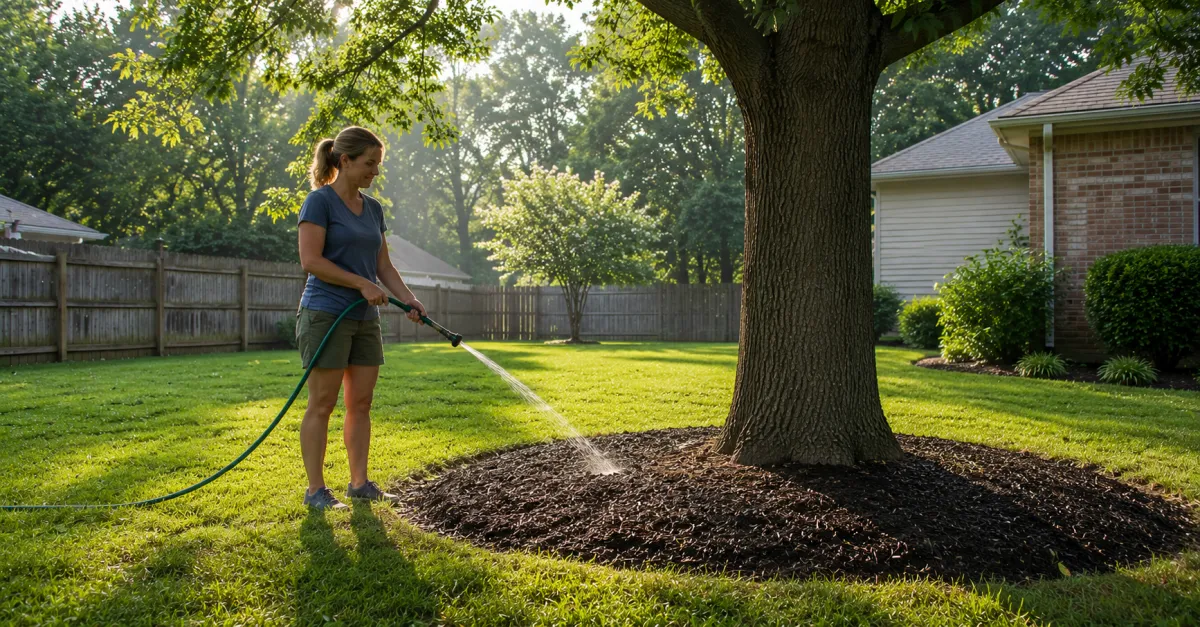
This matters for watering because the base of the trunk is the wrong place to focus. Water poured at the trunk mostly runs off or soaks into an area with few feeder roots. You want to be watering under the drip line — the outer edge of the canopy — and working inward from there.
A soaker hose laid in a ring around the tree at that radius is one of the most effective setups you can use. A slowly trickling garden hose moved to several positions around the canopy is a workable alternative.
Deep and Infrequent Beats Shallow and Frequent
This is the principle that matters most.
A quick watering every day does less good than a long, slow, deep soak once a week. You want the moisture to get down 6 to 9 inches into the soil — deep enough to reach where the roots actually are. Shallow watering just keeps the surface moist, which encourages shallow root growth over time and makes the tree more dependent on frequent watering, not less.
The test: after watering, push a screwdriver or a stick into the soil near the drip line. If the soil is damp 6 inches down, you’re in good shape. If it’s only damp an inch or two, you need to let it run longer.
Water early in the morning. Mid-afternoon watering loses a significant portion of what you put down to evaporation before it even reaches the roots. Morning watering gives the soil a chance to absorb it before the heat peaks.
How Much Is Enough?
For established mature trees, a general guideline is about 10 gallons of water per inch of trunk diameter per week during dry periods. A tree with a 6-inch trunk diameter needs roughly 60 gallons in a week without meaningful rain. That’s more than most people realize.
For newly planted trees — anything in the ground fewer than three years — watering needs are even more critical. Their root systems haven’t had time to extend into the surrounding soil, so they’re entirely dependent on what you give them. Newly planted trees in their first summer need to be watered more frequently, roughly every 3 to 4 days during dry stretches.
Chattanooga summers can go through stretches with very little rain, and July and August are often the driest months. If it hasn’t rained meaningfully in a week, your trees — especially newer ones — likely need supplemental water.
Mulch Multiplies Your Effort
A 3-inch layer of mulch over the root zone does a remarkable job of holding onto the moisture you put down. Without mulch, bare soil in the Chattanooga summer heat can lose a significant portion of its moisture to evaporation within hours.
Mulch also keeps the soil cooler, which reduces the stress load on roots, and it breaks down over time, improving soil structure. If you’ve got trees without mulch rings, adding that layer is probably the single most impactful thing you can do for them this summer.
One important note: don’t pile mulch against the trunk. Pull it back a few inches from the base and spread it outward. A volcano of mulch against the trunk holds moisture against the bark and can cause rot over time.
Signs You’re Not Watering Enough
Wilting leaves, especially in the afternoon heat
Dry, cracked, or pulling-away soil around the root zone
Leaves curling inward
Brown or scorched leaf edges
Early leaf drop
If you see several of these together, bump up your watering frequency before other problems develop.
Signs You’re Watering Too Much
Overwatering is also possible, especially in Chattanooga’s clay-heavy soils that don’t drain as freely as sandy soil. Signs include:
Soil that stays soggy or muddy well after watering
Yellowing leaves with no brown edges (different from drought stress)
Fungal growth at the base of the tree
A general mushy or soft feeling to the soil around the root zone
The goal is moist soil, not waterlogged soil. Let the top few inches dry out between waterings.
A Simple Summer Routine
If you’re looking for a starting point:
Established trees: One deep soak per week during dry spells. Water early in the morning, focused under the drip line.
Newly planted trees: Every 3 to 4 days, same technique.
After a good rain: Skip that week’s watering and let the natural moisture do its job.
Ongoing: Keep mulch rings topped up at 3 inches, pulled back from the trunk.
That’s really it. It doesn’t take a lot of time — it just takes some consistency.
If you have questions about a specific tree, or you’re seeing signs of stress you can’t quite identify, give us a call or text at (423) 443-4533. Happy to talk it through.