Branches Over the Roof: How Much Room Your House Actually Needs
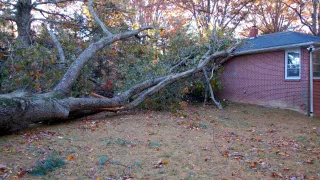
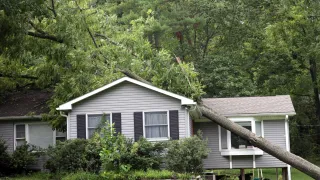
You hear it on a windy night. A soft scrape across the shingles, then again a few seconds later. In the morning you walk out to the driveway, look up, and there it is. A limb from the big oak is resting on the roof like it's always been there.
Branches grow toward open light, and the space over a house is open light. A limb that cleared the roof a few summers ago can be lying on it now, and nobody sees it happen.
So now you've got two questions. Is that a problem? And if it is, does it mean a trim, or the whole tree?
Here's the short answer on tree branches over roof lines. A branch over the house isn't automatically trouble. A branch touching it, or a dead one hanging over it, is. And most of the time, the fix is a trim, not the tree.
Branches Over a Roof Are Usually Fine. Branches on It Aren't.
Shade over a roof isn't the issue. Contact is.
Here's what a limb touching the roof does over time:
- It rubs. Every gust drags it back and forth over the same few shingles, and that wears at them.
- It feeds the gutters. Leaves, twigs, and seed pods drop straight in. A limb hanging over the gutter line is often why one stretch clogs before the rest.
- It gets heavier. Wet leaves load a limb down, and so does ice in the winters we get it. One that barely clears in September can be on the roof by January.
- Dead wood falls where it hangs. A dead branch over the yard drops on the grass. Over the house, it drops on the house.
If one corner of your gutters always seems to be the full one, we've written about how trees cause gutter problems and what helps.
How Much Room Your House Needs
Enough that nothing touches the roof or the gutters when the wind blows.
That's the measure, and it's why the answer is different for every tree. A long, limber limb swings and sags farther than a short, stiff one. A fast-growing tree fills back in sooner than a slow one. And a branch carrying a full load of wet leaves sits lower than the same branch does bare in February.
So the room a roof needs is judged tree by tree. It comes from how each limb moves in weather, not just where it sits on a calm afternoon.
You can get a pretty good read from the ground yourself:
- Watch on a windy day. Look at any tree branches over roof edges and see where the tips travel. If they reach the shingles or the gutter, they're too close.
- Look for the worn spot. A patch of scuffed or bare-looking shingles under a limb usually means contact.
- Listen. That scrape at night is the tree showing you where it's touching.
Why Topping Isn't the Fix
When a tree is crowding the house, it's tempting to cut the top out and be done with it. David recommends never topping a tree.
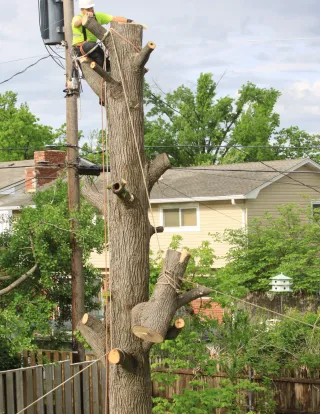
Topping means cutting the main branches back to stubs. The tree answers with a lot of fast new growth from the cuts. That growth is weakly attached, because it's coming out of a wound instead of a proper branch. Within a few years there's more weight up top than before, and it's hanging on by less.
Over a roof, that's the opposite of what you wanted.
The International Society of Arboriculture calls topping "perhaps the most harmful tree pruning practice known." We've gone into it further in The Truth About Topping Trees (And What to Do Instead).
How Clearance Pruning Gives the Roof Room
Clearance pruning takes limbs back from the house without leaving stubs. Here's what that looks like:
- Branches come back to a healthy limb the tree can keep growing from
- Dead, broken, and crossing branches come out, starting with the ones over the house
- The canopy gets thinned where it's too thick, so wind can move through it
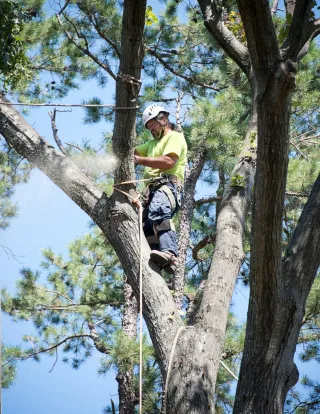
On the day, limbs over the roof are lowered on ropes where they need to be, so nothing lands on the shingles. Some of the work is done from a bucket, and some by a climber up in the tree. Where equipment has to cross the yard, mats go down first. When the work is done, the limbs and brush are cleaned up, the area is raked, and the drives and walkways are blown off.
The house gets its room back, and the tree keeps its shape. That's the whole idea behind our tree trimming.
One Limb, or the Whole Tree?
A lot of the time, the whole job is one or two limbs. If that's all you want done, that's all you'll be quoted for.
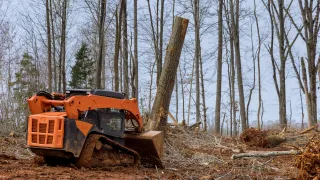
Other times, trimming can't fix what's going on. A tree may be dead, badly damaged, or unsound in a way that cutting branches won't reach. If that's the case, David will tell you and explain what he's seeing. We handle removals too, but nobody walks up assuming the tree has to go.
And sometimes the limb that worried you has more room than it looked like from the kitchen window. You'll hear that too.
When a Power Line Runs Through the Tree Over Your Roof
Take a look at the wire that runs from the pole to your house. It often passes right through the same branches that hang over the roof.
That line is usually the property owner's responsibility. If it's going to be a problem, David will point it out. He'll also tell you what to contact your power provider about, and what to say when you call.
Why Late September Is a Good Time to Check Your Roofline
Right now the canopy is still full, so you can see exactly what hangs over the house. Soon the leaves come down, and the ones over the roof land in the gutters. Then come the late-fall storms, and in some winters, ice. That's when a limb that's close is most likely to end up on the roof.
For most trees, the dormant months are the easiest time to trim. A limb already on the roof doesn't need to wait for a season, though. And if the gutters are already full of what the tree dropped, we can clear those while we're there.
Getting a Look at the Limbs Over Your House
You don't need to know how much should come off before you call. Working that out is what the estimate visit is for. David can look at the tree with you and show you which limbs he'd take back. The quote spells out what's coming off.
If there's a limb on your roof, or one you've been keeping an eye on, we're glad to come take a look.
Estimates are free. Call or text (423) 443-4533, or request a quote online.
Sources
- International Society of Arboriculture (TreesAreGood.org), "Pruning Trees": https://www.treesaregood.org/treeowner/pruningyourtrees