Should You Take That Tree Down Yourself? An Honest Way to Decide
The weather's finally cooled off. You've got a free Saturday, a chainsaw that starts on the second pull, and a tree you've been meaning to deal with since spring.
You've cut plenty before. Limbs after a storm, brush along the back fence, maybe a small tree or two. Calling someone for a job you might be able to handle can feel like paying for something you could do yourself.
Sometimes that instinct is right. Plenty of tree work is fine to do on your own. Some of it isn't, and the line between the two usually has less to do with you than with the tree.
Here's how to tell which kind of job you're looking at before you decide on DIY tree removal.
Plenty of Tree Jobs Are Fine to Do Yourself
If you're comfortable with a saw and you use the safety gear, a lot of yard work is yours to take on. The jobs that usually stay on the DIY side look like this:
- A small tree you can see the top of without craning your neck, with open ground all around it
- Brush, saplings, and volunteer trees along a fence line or the edge of the woods
- A low limb you can reach with both feet on the ground
- Limbs that are already down and lying in open yard
What those have in common is control. The wood is light, it's close to the ground, and there's nowhere bad for it to go.
Being good with a saw matters. But most of what decides whether DIY tree removal makes sense is how much weight is up there and where it's going to land.
The Question That Decides It: Where Does the Weight Go?
A grown tree is heavy, and a lot of that weight sits high up in the canopy. Once a cut is made, that weight goes somewhere.
On a small tree in an open yard, it goes onto the grass and you pick it up. On a bigger tree, or one with something next to it, you have a lot less say in where it ends up.
Chainsaw work hurts a lot of people every year. Penn State Extension reports that from 2018 to 2022, nearly 128,000 people were treated in a US emergency department for chainsaw-related injuries. That isn't a reason to sell the saw. It's a reason to be choosy about which jobs you take on with it.
Five Signs a Tree Is No Longer a DIY Job
Any one of these moves a tree out of the Saturday-project column.
1. It's Taller Than the Open Ground Around It
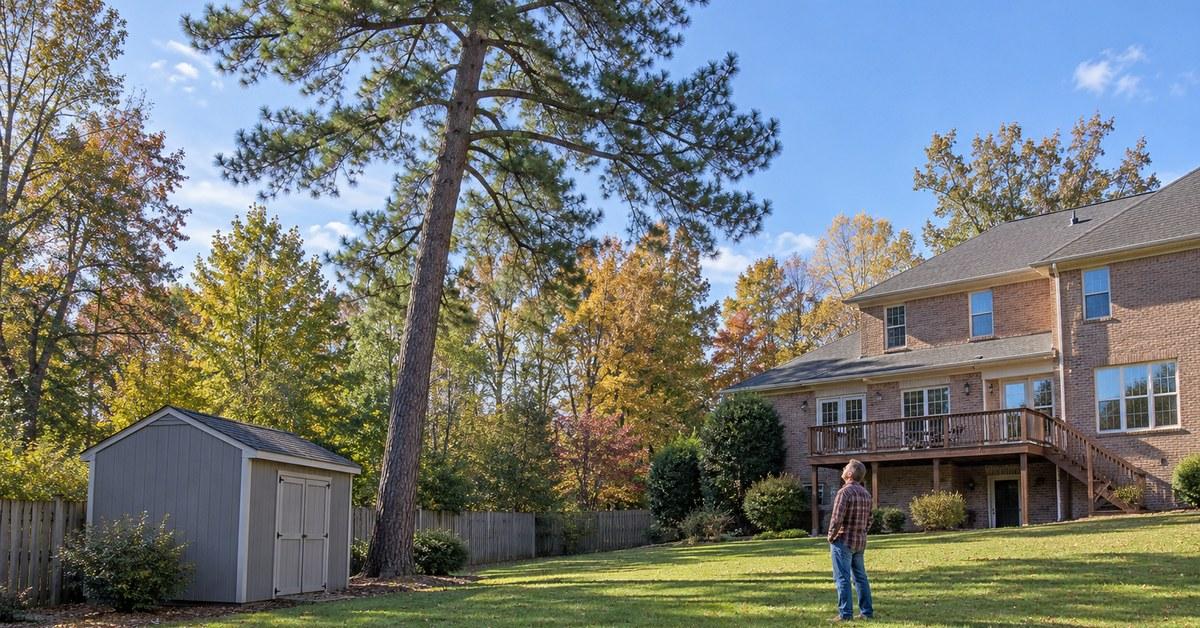
Say you've got a pine about 40 feet tall near the edge of the yard. Does it have 40 feet of open ground to fall into, with nothing in the way you'd mind losing? If not, it can't come down in one piece.
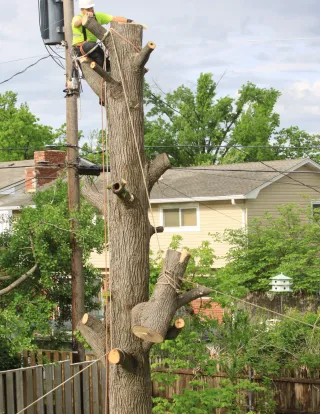
A tree like that has to come down in sections, worked from up in the tree.
2. It Leans Toward Something
A tree tends to come down the way its weight wants to go. If it leans over the driveway, the shed, or the neighbor's yard, that's where the weight is.
A lean you can see from the porch is worth taking seriously.
3. It's Close to the House, a Fence, or a Building
Anything within reach of the tree is part of the job. That includes the roof, the deck, the fence, the car, and the swing set nobody uses anymore.
When there's no clear ground to drop a tree on, the weight has to be managed piece by piece instead.
4. It's Dead, or Partly Dead
Dead wood is brittle, and it doesn't behave like live wood. A dead tree can shed branches once you start working on it. It also may not come down the way its shape suggests.
Bark falling away? A top that's gone bare? Treat it as a different tree from the one it used to be.
5. The Cut Needs a Ladder
A limb doesn't always drop straight down when it's cut. It can swing, fall one end first, or push off the trunk on its way down.
On the ground, you can step back out of the way. On a ladder, you can't. If you can't make the cut with both feet on the ground, leave that one for someone else.
A Wire Near the Tree Means a Call to the Power Company
Look up before anything else. The line running from the pole to your house often passes right through the branches.
That's not a job for a homeowner's saw, and it's not one to start on your own. It starts with a call to your power company.
That line is usually the property owner's responsibility, which surprises a lot of people. If it's going to be a problem, David will point it out. He'll also tell you what to ask your power company about when you call. Our post on trees and power lines explains which wire is yours and which isn't.
Ask Your Insurance Agent Before a Bigger Cut
Leaning toward doing it yourself? Ask your insurance agent one question first. If the tree lands on your roof, your car, or the neighbor's fence, what does your policy cover?
The answer depends on your policy, so it's worth asking before the saw comes out instead of after.
What a Free Estimate Tells You About the Tree
A free estimate doesn't commit you to anything. David walks the tree with you and looks at what's around it. He's checking the lean, the canopy, what's underneath, and how much room there is to work.
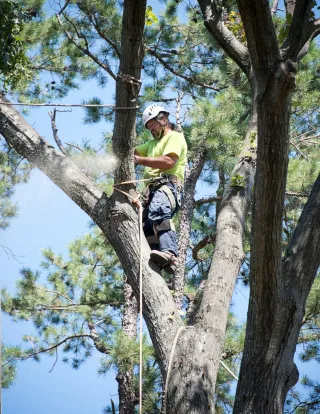
Then he'll tell you how he'd approach it. A big tree near the house usually comes down in sections. Limbs are lowered with ropes, or the work is done with climbing equipment or a bucket, depending on the tree and the property. If you'd like to know more about the service itself, see our tree removal page.
The answer isn't always removal, either:
- Sometimes the problem is one limb, and tree trimming takes care of it. If that one limb is all you want gone, that's all you'll be quoted for.
- Sometimes a tree that looks rough still has years left, and it can safely stay. You'll hear that too.
- Sometimes it does need to come out, and you'll hear why.
There's nothing wrong with handling the small stuff yourself and calling for the part that isn't small.
Not Sure Whether Your Tree Is a DIY Job?
Been standing in the yard, sizing up a tree and going back and forth? That's a good time to have someone look at it with you. Either way, you'll know what you're dealing with.
Estimates are free. Call or text (423) 443-4533, or request a quote online.
Sources
- Penn State Extension, Judd Michael and Serap Gorucu, The Dangers of Using Chainsaws (updated December 4, 2024): https://extension.psu.edu/the-dangers-of-using-chainsaws