Trees and Power Lines: What's Yours and What Isn't
Most people assume the power company handles every tree near every wire. It's a reasonable assumption. It's also only about half right, and the half that isn't right is the half in your own front yard.
Trees and power lines is one of those subjects where knowing one distinction saves you a lot of confusion — and occasionally a lot of money. That distinction is which wire you're looking at. Once you can tell them apart, everything else about who's responsible, who pays, and who to call gets a lot simpler.
Here's how it actually breaks down around Chattanooga and North Georgia.
Not All Wires Are the Same Wire
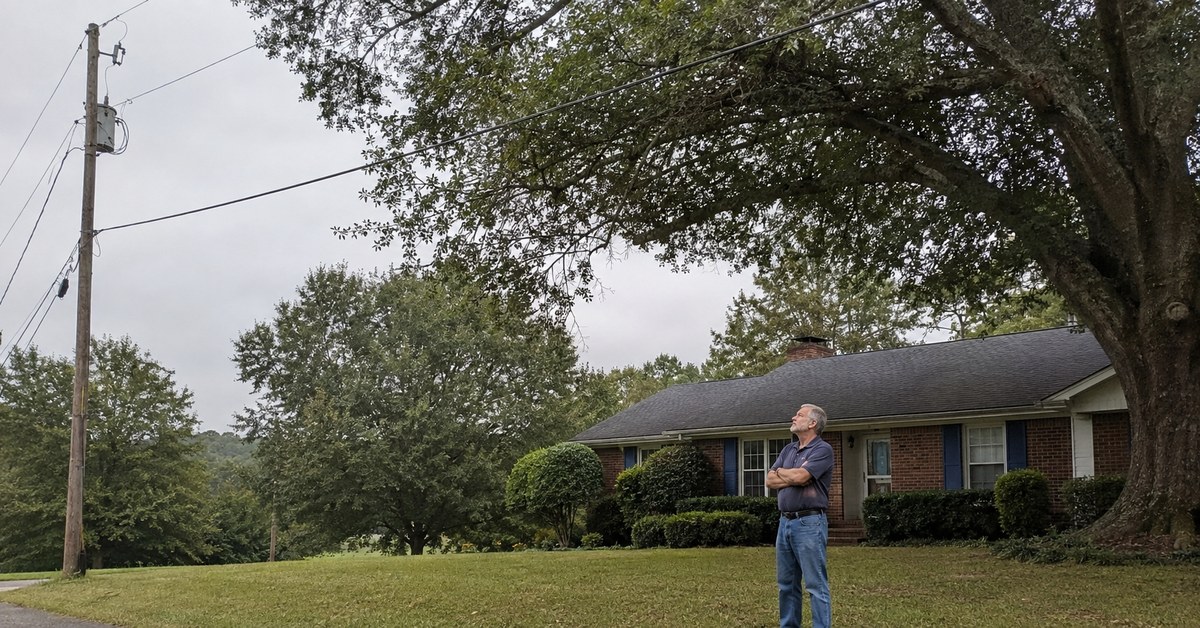
Stand at the street and look up at the pole. You're generally looking at three different things stacked from top to bottom.
- The primary distribution lines — the uppermost wires running pole to pole down the street. These carry high voltage. These are the utility's, full stop.
- The transformer — either the gray can on the pole or the green metal box sitting on the ground at the edge of a yard.
- The service drop — the single line that leaves the transformer and runs across your yard to the corner of your house. This is the one that matters for our purposes.
Almost every argument about tree responsibility comes down to somebody not realizing those are three different things with three different owners.
What the Utility Handles
For the high-voltage lines, EPB does the pruning, and they're required to. The National Electrical Safety Code obligates them to keep vegetation cleared around those lines — generally trees within about 10 feet of high-voltage conductors that are capable of growing into the lines or equipment.
They also maintain clearance around ground-mounted transformer boxes: roughly 3 feet on the sides and 12 feet in front of the box, so crews can open it and work safely. If you've been planting shrubs around that ugly green box to hide it, that's the number to know. Higher-voltage lines require larger clearances still.
The thing worth understanding is the timeline. EPB maintains thousands of miles of line. Even trimming well over a thousand miles a year, a full pruning cycle across the whole system takes several years to come back around to any given street. So "EPB will get it" is true, but "EPB will get it this month because I noticed it" usually isn't.
If a tree is genuinely contacting a primary line, or a limb is resting on a high-voltage wire, that isn't a scheduling question — call EPB and report it directly. That's an urgent safety issue and it's theirs.
The Part That's Actually Yours
Here's the piece that catches people: the service line running from the transformer to your house is your responsibility.
That's the wire crossing your yard to the weatherhead on your roofline or the meter on your wall. If your silver maple has grown up around it, if a limb is rubbing the wire every time the wind blows, if the line disappears into your dogwood — that's a tree on your property interfering with your service, and dealing with the tree falls to you.
You were smart to look up and notice it, because this is genuinely the kind of thing that sits unnoticed for years. Wire rubbing against bark eventually wears through the covering. That means an outage at your house, sometimes a damaged mast where the line attaches, and occasionally a repair bill that's a good deal larger than the trimming would have been.
The Free Thing Almost Nobody Knows About
This is the most useful paragraph in this article, so here it is plainly.
EPB will come out and lower your service line at no charge so a tree contractor can safely prune and remove the growth around it, then reinstall the service afterward — also at no charge.
That's it. That's the whole trick. You're not stuck choosing between "leave the limb rubbing the wire forever" and "pay somebody to do something dangerous." You schedule the drop, the tree work happens with the wire safely out of the way, and the power goes back up.
You'll want to coordinate the timing so the drop and the tree work line up on the same day, and it's worth confirming the current process when you call — but that service exists and it's the right way to handle this.
If you're going to remember one thing from this piece, remember that.
If You're in North Georgia, Ask Your Own Provider
Everything above is EPB's policy, and EPB serves Chattanooga and the immediate area. Plenty of our customers are down in Walker, Catoosa, and Dade counties, and those addresses are served by a different utility entirely — a co-op or another provider with its own rules.
The general structure tends to be similar: they handle the high-voltage lines, the service drop to the house is the property owner's. But the specifics vary, and whether they'll drop a service line for free is exactly the kind of detail that differs between providers. One phone call to your own utility answers it. Ask them two questions: do you clear around my service drop, and will you disconnect it temporarily for tree work.
What Not to Do Yourself
I don't like writing paragraphs that sound like warning labels, so I'll keep this short and honest.
Assume every wire in your yard is live and dangerous. The covering on a service drop is weather protection — it is not safety insulation, and it degrades with age and sun. People are hurt every year making the reasonable-seeming assumption that a coated wire is a safe wire.
Don't put a pole saw, a ladder, or a pruning pole anywhere near a line. Aluminum and wet fiberglass both conduct. A branch you're cutting can swing into a wire on the way down. This is one of the few areas in tree care where there's not really a safe do-it-yourself version.
Don't let a tree service talk you into working around an energized line either. Line clearance work is its own specialty with its own qualifications. The right answer from any honest tree company is "let's get the utility to drop that first."
Planning So This Doesn't Repeat
The long-term fix is boring but it works: pay attention to what gets planted where.
If there's a service line or a primary line crossing a section of your yard, that's the spot for something that tops out at 20 or 25 feet — a dogwood, a redbud, a serviceberry, a crape myrtle. Save the oaks, poplars, and maples for the open parts of the property where they can get to full size without a conversation with the utility every few years.
A tree planted in the wrong spot isn't a mistake you notice for fifteen years. Then it's a mistake you notice every year for the rest of the tree's life.
When It's Worth Having Someone Look
If you've got growth crowding the line to your house, a limb resting on a wire, or you just can't tell which wire is which from the ground, that's a reasonable thing to want a second set of eyes on. Sometimes it's genuinely hard to judge clearance by looking up from the driveway.
We're happy to take a look, tell you honestly whether it's a this-year problem or a next-few-years problem, and help coordinate with the utility if a drop needs to happen first. Estimates are free. Call or text (423) 443-4533.
And if a tree is on a high-voltage line right now, don't call us first — call EPB or your utility, and stay well away from it.