
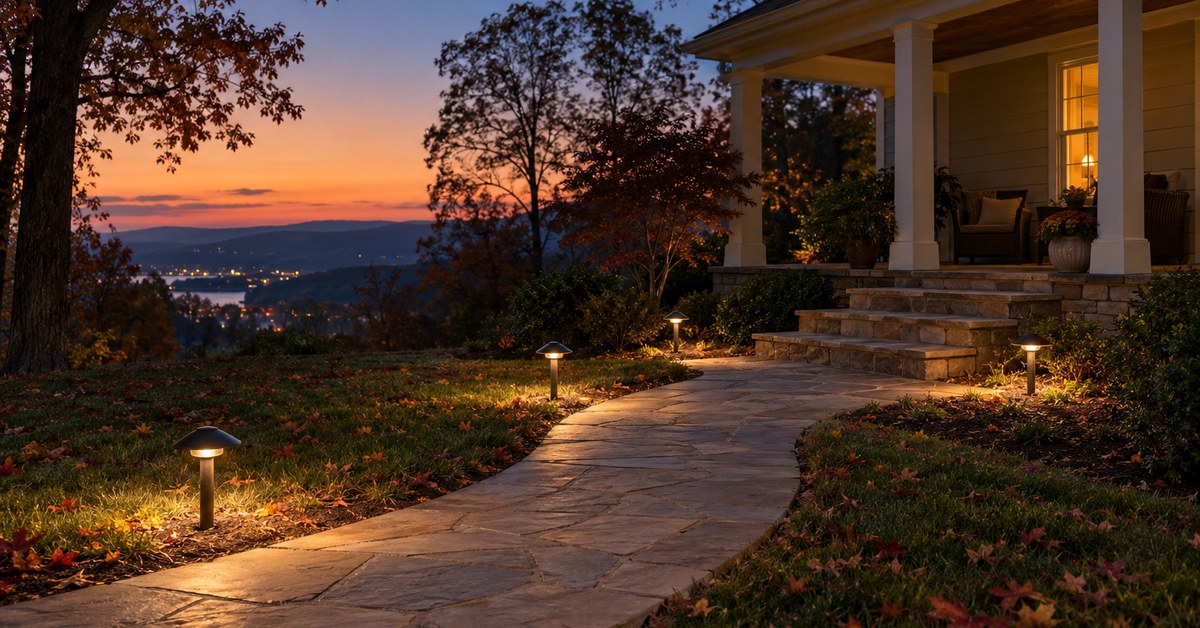
You park in the drive, turn off the car, and it's already dark. The porch light is on, but it lights the door, not the steps below it. So you feel for the edge of each step with your foot. The phone flashlight is in one hand and a bag of groceries is in the other. Wet leaves on the walk don't help.
That walk got darker this week. The clocks went back an hour early Sunday morning, and a lot of evenings now end with pulling in after dark.
It's a small problem. It's also one you'll meet every evening until the clocks go forward again in the spring. Landscape lighting is how you stop meeting it: light along the path, up the steps, and wherever else you'd like to see after dark.
What Landscape Lighting Is For
Mostly, it's for seeing where you're going. The places people want lit are usually the ones they walk every day:
- The front steps, especially the top one and the bottom one
- The walk from the drive to the door
- The driveway, so you can see its edges pulling in or backing out
- The path out back to the shed, the garden, or the gate
- The spot you'd sit in on a mild evening, if it's dark by the time you get out there
That last one isn't about tripping. It's about getting some use out of the yard after work, now that after work means after dark.
Light the Ground Where Your Feet Go
With landscape lighting, it's easy to think the answer is more light. Usually it's light in the right places.
A step is hard to see at night because its edge disappears. The step and the drop below it turn into the same shade of gray. What helps is light on the steps themselves, falling where your feet land. A path works the same way. You want to see where it turns and where it ends.
A light shining toward your eyes works against you. It's bright, but the step behind it gets harder to see.
So start with where you walk and where you've stumbled. Say you've got a front walk that bends once and ends in three steps up to the porch. The bend and those three steps are where the light needs to fall first.
Where the Light Falls, and Where the Power Comes From
When we come out, the lighting comes down to two questions.
Where does the light need to fall? Walk us through the yard the way you'd walk it at night. Show us the step you miss and the stretch of drive you can't see. If there's a corner out back you'd use more if you could see it, show us that too.
Where does the power come from? The lights need power, and it has to get from where it is to where they're going. Sometimes that's a short run along the house. Sometimes it's all the way across the yard.
Then you get a price for the work and what's in it. You decide from there.
Getting Power Across the Yard Means a Trench
If the line has to cross open ground to reach the lights, that's trenching. We do that too, so you're not lining up the dig with somebody else.
If your electrician is part of the job, they decide where the line runs and how deep it goes. We dig to that.
Before any ground is opened, 811 gets called. The buried utility lines coming onto the property are marked first. On the Georgia side, that's Georgia 811. On the Tennessee side, it's Tennessee 811.
A locate has one blind spot. It won't find a line somebody ran on their own. Maybe a previous owner ran power out to the shed. Maybe there's an old wire to a yard light nobody remembers putting in. If you know about one, mention it at the visit, even if it's only a hunch.
The route matters too. The straight line across the yard might pass right under a big oak. Sometimes going around the tree is the better trench, and you'll hear that when we walk the route. If there's a tree near the run you'd like to keep, our article on tree-friendly hardscapes explains why its roots are worth working around.
Path Lighting Stays Up All Year, Unlike Holiday Lights
Lighting along a path or up the steps is permanent. It's there in July when you get home late from a cookout, the same as it is this week.
Lights strung in the trees for December are a different job, with different things to watch for. If that's what you have in mind this season, our post on holiday lights and tree safety is worth reading before anything goes up.
When the Path Itself Could Use Some Work
Sometimes the trouble at night isn't only the dark. The way to the shed is a worn track that turns to mud after a rain. Or there's no clean edge where the walk meets the grass.
Rock, gravel, and stone work is something we do as well. Thinking about a gravel path to the shed? The path and the lights along it can be talked through on the same visit.
Had a Dark Walk to the Door This Week?
Next time you're feeling for that bottom step, remember which one it was. Show us that step when we come out, along with the stretch of drive you can't see, and we'll work back from there to where the power comes from.
We work throughout Greater Chattanooga and Northwest Georgia.
Estimates are free. Call or text (423) 443-4533, or request a quote online.
Sources

Out On A Limb For You
Tree and property care from Flintstone, Georgia. Our owner, David Hooper, has worked on Greater Chattanooga trees and yards for more than 25 years.