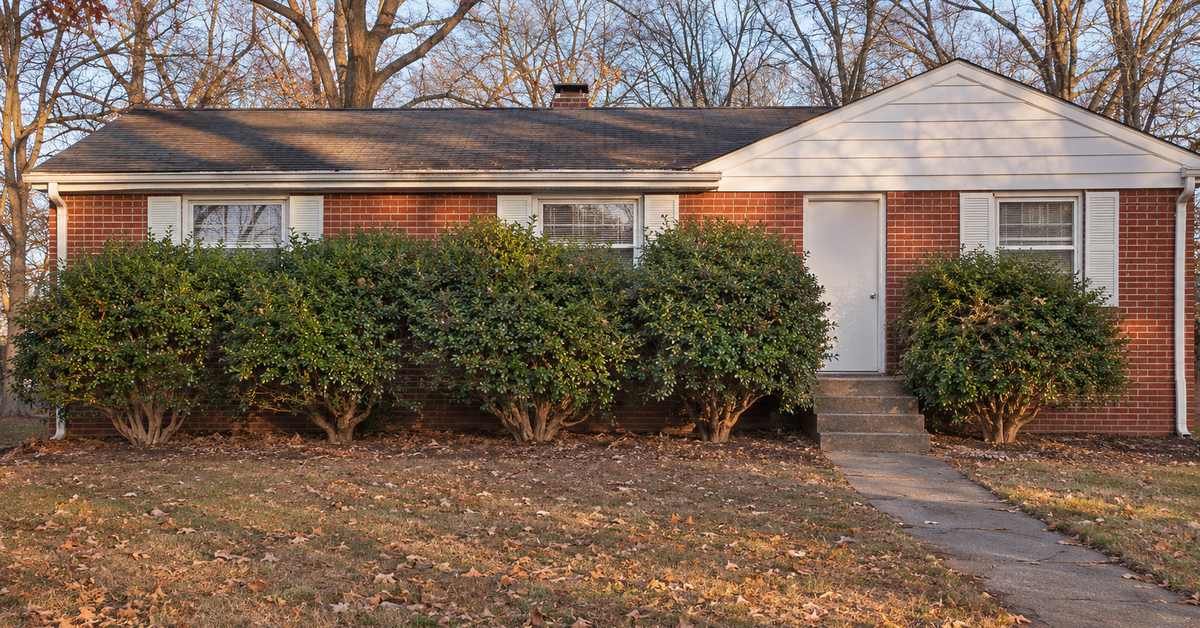
Almost every house seems to come with one. A shrub somebody planted by the front window years ago, back when it was the size of a basketball and the tag promised it would stay "compact."
It did not stay compact.
Now it reaches the top of the glass, the front room gets a little darker every year, and you've quit opening those blinds because there's nothing to look at but leaves. Or maybe it's the pair by the steps that you turn sideways to squeeze past with the groceries. Or the row along the front that's gone brown and bare in the middle, with a little fringe of green around the outside, like a bad haircut growing out.
So you land on the question a lot of people around Chattanooga land on this time of year. Cut them back hard and hope they fill in? Or pull them out and start over?
November is honestly a good month to decide. The leaves are down, the summer growth is done, and the front of the house is about as easy to see for what it is as it's ever going to be.
Signs a shrub has outgrown its spot
A shrub doesn't have to be dead before taking it out makes sense. Usually it's one of these:
- It covers a window, and the room behind it has gotten dim
- It crowds the steps or the walk, so getting to the door takes a little sidestep
- It rubs the siding or leans into the house every time the wind picks up
- It's gone bare inside, brown in the middle with green only on the outside edge
- It's a hedge you're tired of shearing every few weeks all summer
- It came with the house, and you never actually picked it
And sometimes you just never liked it. I'll say it plainly: that's a perfectly good reason. It's your front yard, and you're the one who looks at it every day.
Cutting a shrub back hard instead of pulling it out
If you like the shrub and only mind its size, there's a middle path, called rejuvenation or renewal pruning. The main stems get cut back to about 8 inches above the ground, and the plant grows back from there.
It sounds brutal, and for a while it looks it.
It isn't for every shrub, either. It works for a lot of them, but not for conifers or boxwoods, so if the row out front is boxwood, this one isn't your answer. It also isn't for a plant you want blooming this coming season.
Timing is where November gets in the way. UT Extension puts it about as plainly as an extension publication ever puts anything: pruning "should NOT be done in the fall." The capital letters are theirs. Summer-flowering shrubs, broadleaf evergreens, and deciduous shrubs that don't flower get pruned in late winter instead. Spring bloomers wait until right after they bloom. The hard cut-back belongs in the dormant season, through the end of February.
So if you go this way, it's a late-winter job. And it's worth picturing what comes after. For a while, the front of your house has a row of 8-inch stubs where the shrubs used to be, and the neighbors will probably ask what happened.
Some folks are glad to make that trade for a shrub they love. Others would rather clear the spot and put in something that fits it. Neither one is wrong.
Taking shrubs out doesn't have to wait
Those pruning windows are about helping a plant you're keeping. A shrub that's coming out doesn't care what month it is. That makes right now a reasonable time to clear out overgrown shrubs, while you can see exactly what's crowding the house.
It can be one bush or the whole run across the front. Just want the one by the door gone? That gets quoted on its own, and the rest stay put. Want the whole front cleared so you can start fresh? That works too.
If you're not sure which ones are worth keeping, that's a good use of the estimate. We'll walk the bed with you and tell you which ones we'd keep, and why. Sometimes it's fewer than you'd figured. Sometimes there's one you'd written off that turns out to be worth saving, and we'll point it out. And sometimes every one of them goes, because that's what you wanted, and that's fine too.
What removal day looks like
The shrubs come out tops first, and then the roots.
How much of the root comes out depends on the shrub. Some come up easier than you'd expect. Some have been there so long they've got no intention of leaving. We do our best to get them out, but I'm not going to tear up the whole bed and half the lawn chasing every last root. We can look at yours during the estimate and tell you what to expect.
What's cut either leaves with us or stays on the property, whichever you'd rather. If you've got woods out back and want it put there, just say so. If it's hauled off, it usually goes to the closest place that takes yard and wood debris.
Got an old stump in the same bed? If there's a tree stump in with the shrubs, or close by, we can grind that too. Stump grinding is quoted separately, so mention it when we come out and we'll look at both.
Pulling out the old and planting the new in one job
Most shrubs come out to make room for something. New plantings sized for the spot this time. A fresh bed with clean mulch. A privacy line along the side of the yard.
We can take the old out and put the new in as one job, so you're not lining up one visit to clear it and another to plant it.
Whatever goes in, my one piece of advice is to choose it for the size it's going to be, not the size it comes in. That cute little shrub in the nursery pot is how every one of these stories started.
If you're picturing a clean bed with fresh mulch where the overgrown shrubs were, we can put that bed in. And if it's a tree, not a shrub, that's crowding the roofline or the windows, the house may need more room than it's getting.
Not sure which shrubs should stay?
- Love the shrub and only mind its size? A hard cut-back can work. It's a late-winter job, it's not for boxwoods or conifers, and it looks rough for a while.
- Ready for it to go? There's no reason to wait. Now is a fine time.
- Not sure? That's what the estimate is for.
Next time you're squeezing past the one by the steps, look at the rest of the row while you're there. Notice which ones you'd miss and which ones you'd be glad to see gone. That's most of the decision right there.
If you'd like a second set of eyes on it, have us out to walk it with you. You'll hear which shrubs are worth keeping, which aren't, and what it takes to clear the spot. You decide from there.
We work throughout Greater Chattanooga and Northwest Georgia. Estimates are free. Call or text (423) 443-4533, or request a quote online.
Sources

Out On A Limb For You
Tree and property care from Flintstone, Georgia. Our owner, David Hooper, has worked on Greater Chattanooga trees and yards for more than 25 years.