
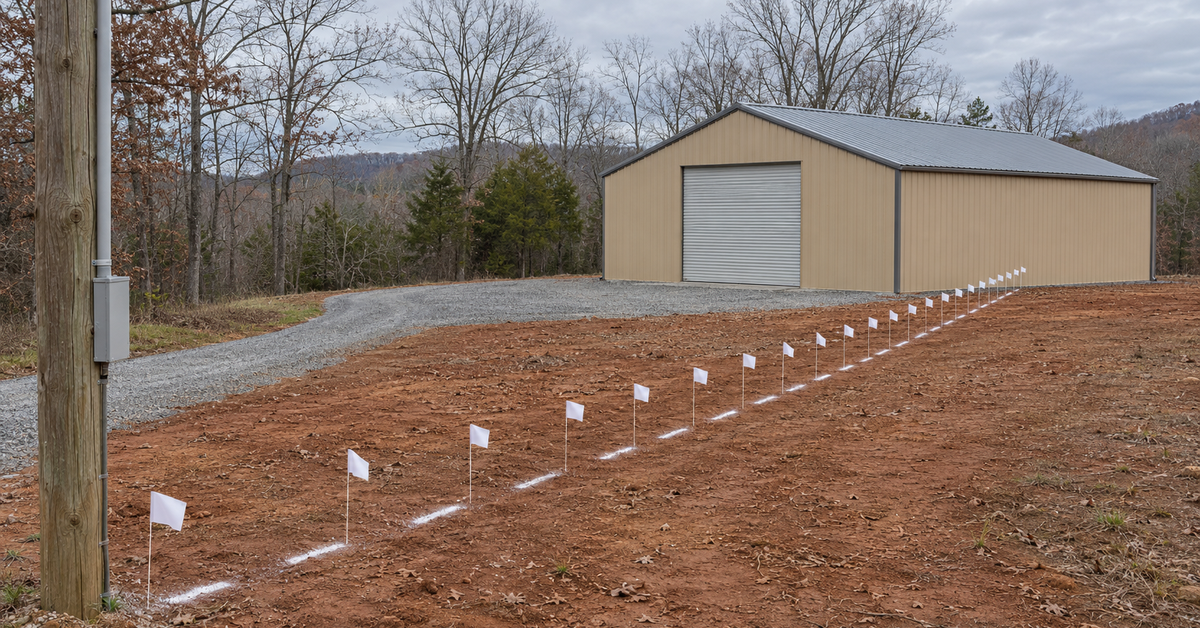
Trenching for power is the step nobody mentions until the shop is half planned.
It goes something like this. You've picked the spot. You've maybe already got the pad cleared, and you've spent more evenings than you'd admit looking at metal building kits on your phone. Then the electrician comes out, looks across the yard at where the shop is going, and says, "Okay, I'll need a trench from here to there before I can run the line."
And you're standing there thinking, who digs that?
It's a fair question, because the trench falls between two jobs. It isn't the clearing, and it isn't the electrical work. Here's how it fits, what goes into the price, and what happens before anybody puts a bucket in the ground.
It's a good week to think about it, too. With Thanksgiving here and the build still months off, there's time to get the trench sorted over the winter, so the spring build isn't sitting around waiting on it.
Who digs the trench for a new shop's power
Clearing gets the site open. The electrician runs the line. The trench is the step in between, and that's our part.
If you're still at the clearing stage, we can clear the site first.
Trenching for power isn't only for shops. It might be:
- Power out to a shop, a barn, or a detached garage
- Power to a gate down at the road
- A run from the meter to wherever the new work is going in
- Lights along the driveway, up the front walk, or down a set of steps
What they have in common is a stretch of open ground between where the power is and where you want it.
If the trench is for landscape lighting, we do the lighting as well, so the dig and the lights can be talked through on the same visit.
Your electrician sets the route and the depth
We dig the trench. Your electrician runs the line.
I want to be clear about that split, because it matters. The route and the depth are the electrician's call, and the trench gets dug to match. Whatever goes in it is their work, and we don't install it. I'd much rather dig exactly what your electrician asked for than guess and have them show up to a trench that's wrong.
If you've already been told a depth, pass it along when you call. If you haven't, that's a question for whoever is running the line.
And if nobody's lined up to run the line yet, mention that, too. The dig and the line have to be timed together. An open trench sitting in the yard for three weeks waiting on an electrician is nobody's idea of a good time, least of all whoever has to walk around it.
No route yet? Maybe you know where the shop is going and haven't worked out how the line gets there. I can walk it with you and talk through where it could go.
What goes into the price of a trench
When I come out, I'm looking at:
- Where the trench starts and where it ends
- What it has to get past, like a driveway, a walkway, a bed, or a tree
- The slope of the ground along the run
- How equipment gets to it
- Anything already buried out there that you know about
How far it runs, how deep it needs to go, and what it has to cross all go into the price.
Then you get a price for the dig, and it spells out what's in it. You decide. If it's a go, we set the day with you, around when the line is going in.
811 gets called before anyone digs
Before any ground is opened, the utility locate gets called. You don't have to make that call yourself. It gets called as part of the job.
On the Georgia side, that's Georgia 811, which is free and can be reached at 811 or 800-282-7411. On the Tennessee side, it's Tennessee 811. Either way, the number is 811, which is about the easiest number anybody's ever had to remember.
The buried utility lines coming onto the property get marked before the digging starts.
A locate has one blind spot, though, and it's the one I'd want you to know about. It won't find a line somebody ran on their own. Maybe a previous owner ran power out to an old shed. Maybe there's a wire to a yard light nobody remembers putting in. Out in the country especially, there's often a little history under the grass.
If you know of one, tell us. If you've only got a hunch, tell us that too. "I think the old owner might have run something out to that shed" is a genuinely useful sentence.
The straight line isn't always the best trench
Sometimes the straight line from the power to the shop is the one to dig.
Sometimes there's a driveway or a big tree in the way, and going around it is the better trench. Cutting straight through the roots of a tree you like to save twenty feet of digging isn't much of a bargain. You'll hear which way I'd go before it's priced.
And sometimes it's a shorter run than you'd pictured, and a smaller job.
If the route follows an old fence line that's grown up in brush, that line may need clearing before anything else. We can clear that line first.
If you're the electrician
Need the ground opened on a customer's job? That's a normal call for us.
Tell us the route, how deep you want it, and the day you need it open, and we'll quote the dig.
Planning a shop for the spring?
- The trench is its own job, between the clearing and the electrical work.
- Your electrician sets the route and the depth. We dig to match.
- 811 gets called first, as part of the job.
- Tell us about anything a previous owner may have buried. Even a hunch helps.
- Winter is planning time, so spring is building time.
If you've got the route from your electrician, send it over. If you don't, have us come out and walk the run with you, from where the power is to where the shop is going. Getting the trenching for power settled over the winter is one less thing to chase down when spring comes.
You'll get a price for the dig, and what's in it, before any ground is opened.
We work throughout Greater Chattanooga and Northwest Georgia. Estimates are free. Call or text (423) 443-4533, or request a quote online.
Sources

Out On A Limb For You
Tree and property care from Flintstone, Georgia. Our owner, David Hooper, has worked on Greater Chattanooga trees and yards for more than 25 years.